
I run into Joan Didion everywhere lately. Quotes, subreferences, citations, literally everywhere I turn. (In one of my favorite passages in the Sigrid Nunez novel, the narrator challenges the unchallenged veracity of one of Didion’s most famous memories.) I’ll have more to say about Didion and her present ubiquity — I’m just putting a pin in it for a second — but one of the quotes I’ve recently encountered more than once, which immediately lodged itself in my brain, is “I think we are well advised to keep on nodding terms with the people we used to be, whether we find them attractive company or not,” from the essay On Keeping a Notebook in Slouching Towards Bethlehem, which I bought but haven’t read yet. (I’ve been making my way through The White Album off and on for several months.)
Anyway: notebooks and nodding terms.
Yesterday, my husband sent me a link to this rather dense Popular Mechanics story, Scientists Believe They’ve Unlocked Consciousness—and It Connects to the Entire Universe, which made me want to put together something about the scientific pursuit of spirituality (“It’s just a simple quantum wave …,” the story says), and immediately brought to mind three quotes:
- From Atmos editor Willow Defebaugh, earlier this month: “Restoring balance means elevating all human and non-human life to a place of equal sanctity. It means understanding that the seemingly disparate and many crises we face—whether personal, political, or planetary—are in fact all fractal expressions of the same root dissonance our species has developed between ourselves, each other, and the wider realm of nature. A holistic mindset reminds us that the idea of individuality is subjective, for just as we are part of larger networks and ecosystems, we also all contain microbiomes and communities, thousands of species working in concert to keep ourselves healthy. We are unique creatures, and yet we are also one.”
- From Thich Nhat Hanh’s Living Buddha, Living Christ, 1995 (which I’m perpetually rereading ever since): “Some waves on the ocean are high and some are low. Waves appear to be born and to die. But if we look more deeply, we see that the waves, although coming and going, are also water, which is always there. Notions like high and low, birth and death, can be applied to waves, but water is free of such distinctions. Enlightenment for a wave is the moment the wave realizes it is water. At that moment, all fear of death disappears.”
- And a quote from R. Buckminster Fuller I wanted to track down to get it right. I went through a big Bucky phase 20-odd years ago, and felt certain it was his concept of Universe that I was thinking of.
After fruitlessly riffling through my brain in search of the quote this morning, I turned to Google. There was a new Bucky bio recently that didn’t tempt me, but my search quickly turned up 2016’s You Belong to the Universe: Buckminster Fuller and the Future, which does. However, given that Bucky used the word “universe” a lot and it’s included in that book’s title, which got a lot of press, I was never going to find the quote I was seeking — not that way. And then I recalled an old notebook of mine, still in a moving box in the basement, and felt sure I’d find it in there. So I dug it out, and cracked it open (almost literally).
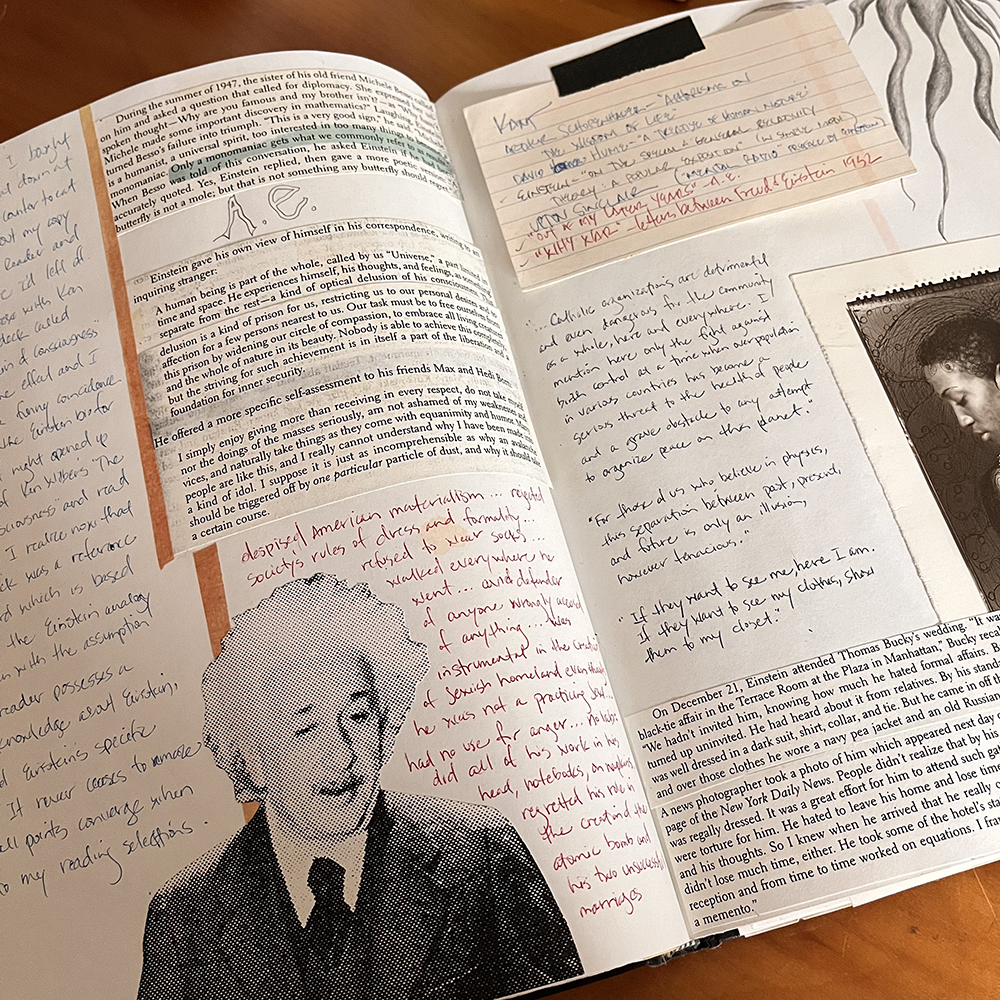
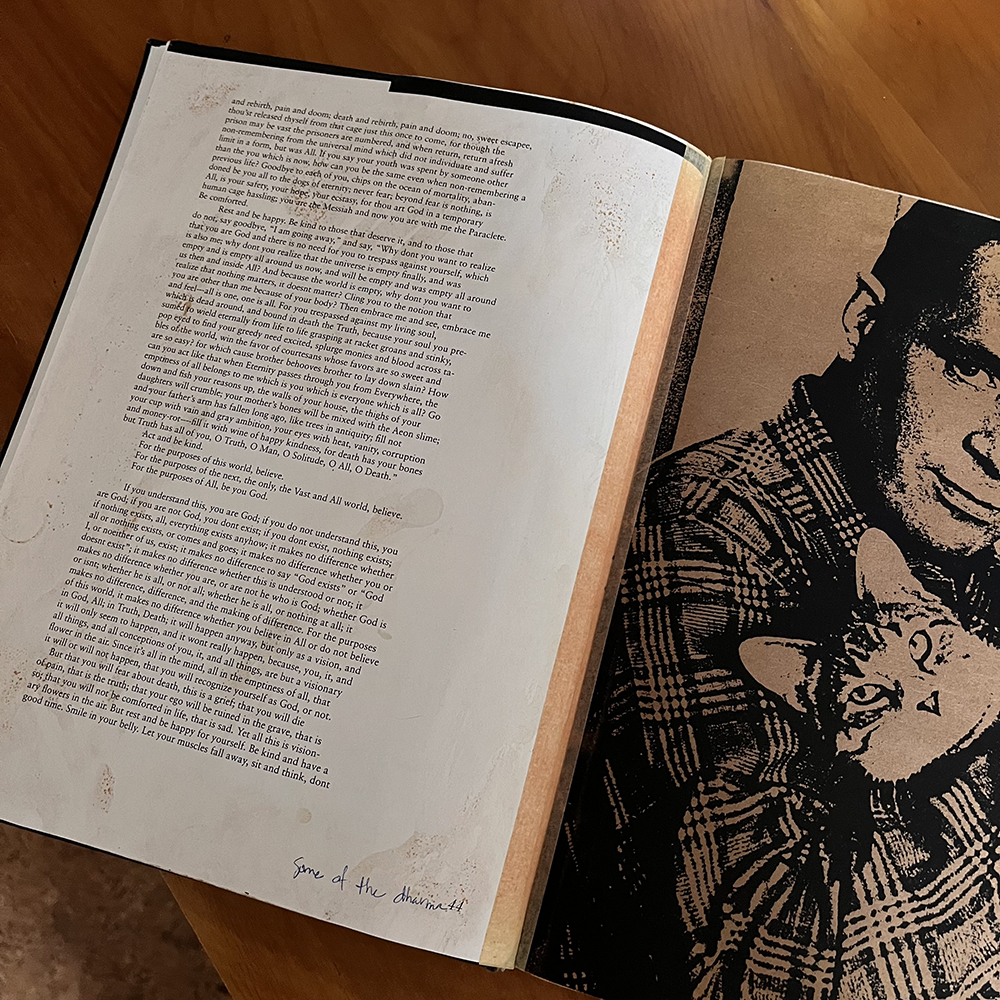
I started this notebook in early 1997, according to the letter I wrote myself within the first few pages. Somewhere between a scrapbook and a commonplace book, it takes up less than half the pages of a large black sketchbook. I was still working as a graphic designer at the time, and was big on brown kraft paper and vellum, so both are layered in — along with handwritten quotes and notes, reading lists, magazine clippings, doodles, photocopies of pages of books, a museum exhibition catalog, some postcards. But all my themes (small structures, rat-race avoidance …) and influences (none stronger than The Book of Tea) are there. Many of the glued-in bits have come loose, but the ideas it held had all adhered to my core more strongly than I even realized.
A few pages in, just past a bunch of Thoreau and a sketch of the little live-work compound I still dream of somehow one day building, there are a few pages from Jack Kerouac’s Some of the Dharma, which I just referenced in the Nunez footnote the other day, along with a full-page photocopy of a portrait of the author with his cat. A page of architectural and interior photos I could happily have pinned on Pinterest today. The 1997 Mirabella magazine interview with Vicki Robin that led to my first reading of Your Money or Your Life. Several spreads later Bucky appears, then disappears just as quickly, to my surprise. A few spreads after that comes an Albert Einstein phase, including copious bits from Denis Brian’s Einstein: A Life, and there I find the quote I had been seeking from the wrong author:
“A human being is part of the whole, called by us ‘Universe,’ a part limited in time and space. He experiences himself, his thoughts, and feelings, as something separate from the rest — a kind of optical delusion of his consciousness. This delusion is a kind of prison for us, restricting us to our personal desires and to affection for a few persons nearest to us. Our task must be to free ourselves from this prison by widening our circle of compassion, to embrace all living creatures and the whole of nature in its beauty. Nobody is able to achieve this completely, but the striving for such achievement is in itself a part of the liberation and a foundation for inner security.”
Handwritten on the opposite page, another: “For those of us who believe in physics, this separation between past, present, and future is only an illusion, however tenacious.” My early-adult and current selves couldn’t agree more.
I appear to have added to this notebook far longer than I recalled. Toward the end are several pages from Still Life with Oysters and Lemon (including, blown up and highlighted, the sentence that inspired the blog title), which according to the notation I made on that book’s title page was 2004. The penultimate entry is the very Thich Nhat Hanh quote above, written out in my then-legible hand. And the final item? An article from Elle magazine about meditation (I still don’t), which ironically has on its reverse side that month’s Ask E. Jean column, along with a big grinning photo of her.
The past is truly prologue.
 Collapse and Delight
4 responses to “The ‘simple quantum wave’ and the former self”
I found this so stimulating to read this morning, thank you! It made me think of two things. One you likely already know: the Thich Nhat Hanh quote put me in mind of Robin Wall Kimmerer’s ‘grammar of animacy’, which she expands on in one of the chapters of Braiding Sweetgrass, but which is introduced here: https://xenoflesh.files.wordpress.com/2017/03/robin-wall-kimmerer.pdf Such a great dive into verbs over nouns. Defrosting my freezer today, with your post in mind, I was trying to think not of chipping off ice, but of coaxing molecules from ‘icing’ to ‘flowing’ (and, saving the meltwater for the plants, to anticipating more verbs to come).
The second was just that this past weekend here in the UK we’ve had the RSPB birdwatch, a citizen science thing where you record the birds you see for an hour. Great stuff. Chatting to my Dad about it yesterday he was beaming to report that 2 goldcrests had visited his garden, and in the right hour! He said it ‘felt like it was the first time ever he’d seen one in the garden itself’… and yet. ‘On checking my records’ [he’s a retired scientist and is so much better than I at keeping notes], ‘I, in fact, saw one in the garden in 1990.’ Your post resonated cheeringly.
p.s. I am half-way through knitting my third sweater from Seasonless. I’m wearing the first, keeping me so warm this stormy day in Glasgow. Plan to wear the second to go for a drink with a friend later. Number three is for my husband. So thank you for that too 🙂
LikeLike
I love that he has a record he could check — and that it goes back that far! I suppose it’s understandable that he might have lost tracking of a sighting from 34 years ago, wow. That’s dedication! I haven’t read Braiding Sweetgrass, and don’t really know what it is, but have seen recommendations here and there. I’ll have to look into it! Thanks for the link and the comment, and am so glad Seasonless is proving fruitful for you.
LikeLike
I haven’t read it yet but my mother recommended “The Other Einstein” to me a few days ago. It sounds like your old notebooks are much more interesting than mine!
LikeLike
Huh, just looked that up and I wonder why she chose to make it a novel.
LikeLike