PART ONE: The Glowing Hawk
Friday evening, I was out for a walk I hadn’t wanted to take. It was cold and very, very dreary, and I didn’t have the energy, but I forced myself out onto the sidewalk. Along the way, the clouds parted a bit, creating a horizontal gash across the sky through which a glimpse of blue appeared (for the first time in days). By the time I was headed back toward my house, the sun was low enough to be creating a golden glow along the horizon, below the blue gash. As I was admiring the scene, a hawk appeared overhead. I slowed to see if I could identify it, and just at that moment it tilted slightly and caught the glow of the sunset, which infused the underside of its wing feathers and gave the illusion that they were lit from within. I stood and watched as it swooped this way and that, in leisurely circles, different sections of feathers lighting up with each graceful tilt of its body — this wing, the tail, the other wing — like those Christmas-tree lights where alternating segments flash on and off. I can’t do it justice but it was literally aglow, and it was one of the most beautiful things I’ve ever seen.
While there was nothing actually electrical happening, no matter how it appeared, just hours earlier I had read this beautiful short piece at Atmos: I Sing the Bioelectric. (You’re welcome for the earworm.)
“Bioelectricity refers to the electric potentials and currents generated and conducted within organisms. These can vary from one millivolt all the way to 1,000 volts in the case of the electric eel,” … and bioelectricity exists in humans as well as other animals. If you had asked me for an example of such a thing, the eel is the only one I might have come up with. But of the examples given, this was my favorite: “bumblebees use the electric fields created by their wingbeats to alter the static electricity of flowers to let other members of their hive know a flower is out of pollen.” You have to read it.
PART TWO: The Technicolor Spoonbill
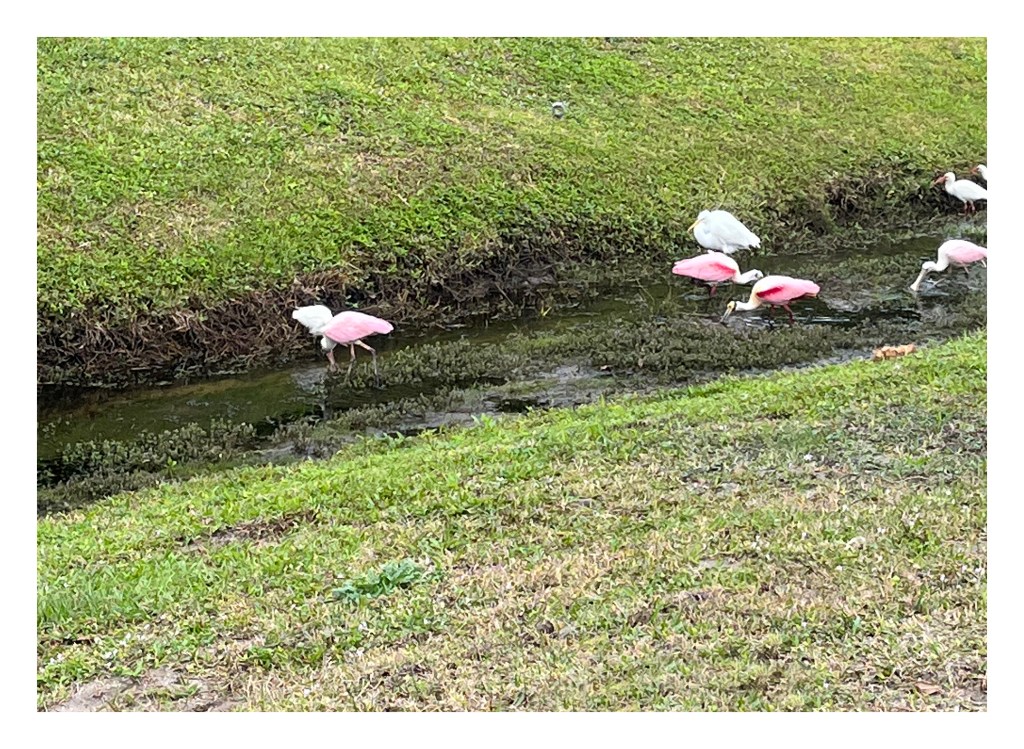
Some of you will know that my husband and I spent two years in Florida during the pandemic. It is not the place for me, but I do love (and miss) the shore birds, especially the roseate spoonbill. For years, we had spotted them while visiting my sister — a faintly pink form amidst the pelicans and seagulls on a bird-sanctuary island just off the coast, or soaring overhead in twos or threes. And all of those years I assumed they were just that: pink. But one day while we were living there, I happened across a handful of them wading around in a flooded roadside ditch, among the usual crowd of ibis and egrets. I pulled over to gawk and got a few hasty and terrible snapshots (see above) (hey, I was illegally parked! and worried they’d fly away!) but I was blown away to discover that in addition to pale pink, they are vibrant magenta, white, yellow and black. So strange and beautiful, and I wished I could have stood there longer, but the other day the Insta-algorithm served me this incredible slow-mo footage of a lone roseate on the ground flapping its wings as it turns, as if showing off the for the camera. Absolutely stunning.
 Collapse and Delight
2 responses to “Birdwatching, real and virtual”
I stubbornly insist on imagining your sister as “a faintly pink form amidst the pelicans and seagulls”, realizing that’s not the intent. Or is it. Lovely, no matter.
LikeLiked by 1 person
beautiful!
LikeLike