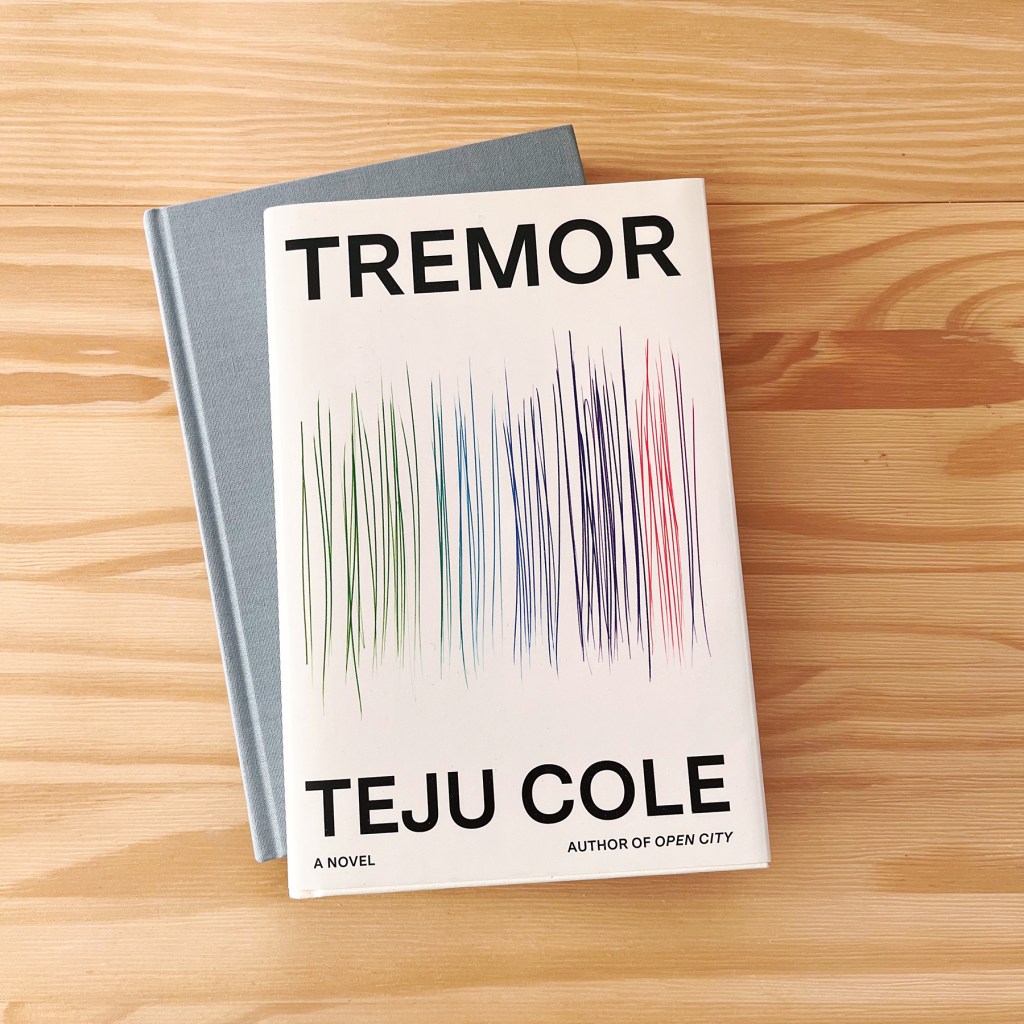
If you’ve read anything by Teju Cole — author, essayist, photographer, critic, teacher — you know that he sees and feels the world with clarity and gravity, and possesses an enviable ability to infuse that into his writing. In addition to bringing a wide and deep experience of the world’s art and music and literature to his work, he sees the literal remnants of slavery, erasure and colonialism all around us (particularly around himself at Harvard, where he teaches) and connects the historical dots — with such short lines.
He also cites his creative influences, in ways both direct and indirect, and there’s a short passage early in his latest novel, Tremor, that feels to me like an apt description of the book itself. This section is written in third person, with the narrator addressing the reader as “you,” assigning you the role of an (as yet unspecified) acquaintance of the main character, Tunde. (Like the author, Tunde also teaches at Harvard and spent his formative years in Lagos, Nigeria.) “You” had recommended a particular recording of Bach’s Cello Suites to Tunde in 2001. “In those days, you were interested in the way Bach’s written scores showed evidence of having originated in improvisation. You described it as ‘embodiment’: the multifocal sensitivity an animal would have in a forest but also the alertness and contained intensity of a hunter in a different part of the same forest. Bach was not merely arranging notes, you said to Tunde at the time. He was conveying a living and intentional search … .”
Tunde, who lives and breathes music, had had his own appreciation for various recordings of Bach’s solo works, in which “he found that quality of personal impersonality that made Bach feel less like a composer and more like a philosopher, a counselor, a scientist, and architect, or a prophet … .” And yet the recording “you” suggested gave him a new level of appreciation.
“You said embodiment was not only the animal in the forest and the tracker following that animal but also the forest as a self-aware system, attentive to the rustle of its own leaves, the shifting colors, the air, the water, the panoptic view of many moving parts, the interactions of light and shade. Collective listening, you called it.”
Improvisation, multifocal sensitivity, alertness, contained intensity, not merely arranging notes, a living and intentional search, personal impersonality, the panoptic view of moving parts, the interactions of light and shade, an author who is a seer and a teacher and an artist — all of this applies to Cole and his novel. It is “a self-aware system” — both in and of itself, and in its seeming anticipation of the reader’s awareness of the overlap between the author and his protagonist. (The book has this awareness in common with the new Sigrid Nunez, along with the bare whisper of a plot, and the tendency toward “essayistic digressiveness.”*)
But the phrase “collective listening” stands out the most. The book’s narration shifts from the third person breaking the fourth wall, above, to a lecture (literally a museum talk) by Tunde — or Cole himself? — on museums and the provenance of their possessions (which I desperately wish lived on its own somewhere that I could link to), to — eventually — Tunde and his wife Sadako taking turns speaking for themselves. Within that “eventually,” at the center of the book, lives an entire short fiction collection: two dozen of the most dazzling, vivid, memorable pieces of flash fiction you could ever hope to read, each one the first-person account of a citizen of Lagos, which (echoing Every Day Is for The Thief) Tunde returns to for a visit decades after having moved to the US. And, before shifting back to Tunde and Sadako, the shorts are followed by a chapter that is a portrait of Lagos itself, a place “that only tolerates cartography on a scale of 1:1.”
I feel the same way about this book: it’s impossible to do it justice in fewer words than are contained in the book itself. So while I could go on and on and on — in fact, I’ve written and discarded twice this many words — I’d much rather you be reading Tremor!
p.s. If someone were to buy the book through this link so I could be sure the affiliate links are actually working, I would really appreciate it!
//
*Don’t miss this link to an old Nunez interview at The Paris Review that’s currently unlocked!
[ IMAGE: Photo of Teju Cole’s book Tremor stacked on top of Human Archipelago ]
 Collapse and Delight
One response to “On Teju Cole’s “Tremor””
[…] hadn’t thought to look for with regard to Teju Cole’s brilliant novel Tremor, which I had just posted my thoughts about. I’d made a comment about wishing the novel’s embedded museum lecture was available somewhere I […]
LikeLike